
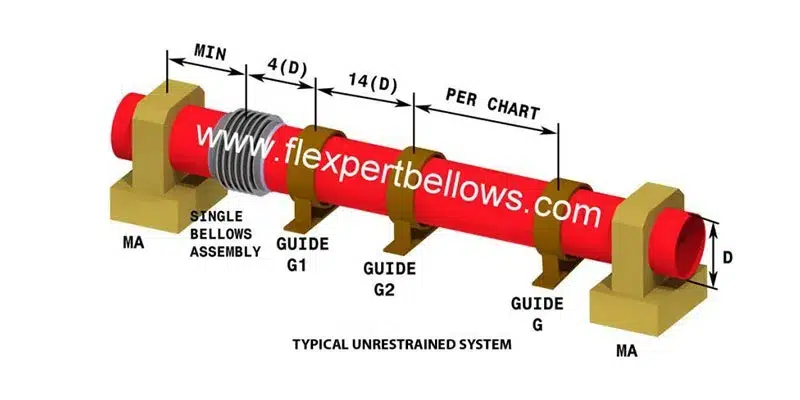
In each piping system-on commercial buildings, industrial facilities, or residential homes-pipe movement and restraint of stress are essential to performance and safety. Elongating, shrinking, and vibrating due to temperature, pressure, and mechanical loading, pipes are restrained by this motion without end from failure and leakage. Pipe guides and anchors restrict motion, support piping alignment, and shield piping and equipment. Besides, to protect the piping system, obtaining the most suitable axial expansion joints is required and beneficial.
Pipe guides provide controlled linear pipe movement, for the provision of thermal expansion allowance, and prevent lateral movement. Anchors restrain the pipe to a definite position, to take up forces and provide fixed points of reference. All work together in providing desired movement where desired and preventing stressing of supports and joints. Placing anchors and guides is crucial to the health and effectiveness of a piping system.
Functions of Different Pipe Guides and Anchors in the Healthy System
Pipe systems are critical to industrial, commercial, and residential functions, depending on proper control of motion and support. Pipe guides and anchors are single-piece fittings that render piping systems dependable and durable. These are their most important functions:
- Directed controlled movement
Pipe guides facilitate controlled axial pipe motion and limit lateral movement effectively. It is an important feature in facilitating thermal contraction and expansion to enable pipes to travel securely and as anticipated. Pipe guides need to be installed to keep free movement from happening, thereby causing misalignment, stress accumulation, and system failure due to their absence. Pipe guides have to be installed to keep piping systems reliable and intact.
- Absorb and manage thermal expansion
Piping containing hot or cold fluid increases or decreases in size when there are temperature changes. Pipe anchors firmly fix the pipe in position in the critical locations, and guides provide expansion safety in specified directions. This deliberate control of expansion gives life to the integrity of the flanges, joints, and equipment fitted thereon and stops them from enduring any type of stress or damage. As a superior top axial expansion bellows manufacturer, you are essentially assuring the health of the pipework system and safeguarding it against any form of damage.
- Shield extensive joints
Expansion joints also regulate pipe movement, and optimal performance is achieved when the movement is properly regulated. Guides regulate movement excellently in the axial direction alone, and never twist, bend, or cause lateral strain. Anchors regulate movement excellently just where necessary, considerably increasing the joint’s life and maintaining safety levels.
- Prevent buckling and sag of pipes
Mal-supported or under-supported pipes would buckle by their own weight or buckle with overpressure, particularly at elevated temperatures. To prevent such an issue, proper pipe guide location with properly spaced guides and strong anchors provides the necessary structural support. This not only minimized the possibilities of physical distortion but also provided for the prevention of probable eventual damage, thereby providing long-term reliability and integrity of the piping system.
Conclusion
Pipe guides and anchors are not trimmings, but an essential aspect of building a safe, efficient, and durable piping system. By restricting movement, loading, retention in thermal expansion, and safeguarding sensitive joints and equipment, they prevent destruction, reduce maintenance, and extend the life of the entire system by years. From high-pressure steam mains to general water systems, properly designed guide and anchor installations are the secret to an actual healthy piping system.