
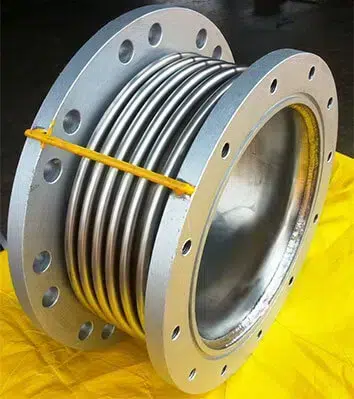
In essence, when you specify a universal expansion joint for your piping system, you are talking of a hidden genius. This single component manages three extremely demanding forces at once. First, the constant movement pulls in different directions. Second, the temperature extremes that push its material limits. Finally, the internal pressure is attempting to tear it. Understanding how these forces interact is necessary. Especially if you want to select a joint that will work reliably for years.
Universal joint bellows are generally made up of two bellows parts. These two parts are then connected by a common spool piece. A joint of this category is often employed where greater lateral movement needs to be absorbed. This movement is usually beyond the capabilities of a single Axial Expansion Joint.
How Do Universal Joints Battle These?
If you are wondering why your piping system needs this incredible technology, and how it works, you are in the right place.
1. Temperature
Temperature cycling has its own set of issues. The universal expansion joints are formed of a material that expands and contracts with each cycle. This happens because of heating and cooling. The change in temperature creates a sense of fatigue at each convolution. Every year, a power plant expansion joint may go through thousands of heat cycles. This causes microscopic cracks to gradually form and spread. Because each cycle uses up a very small portion of the material’s fatigue life. Hence, this shock results in uneven expansion and high localized tensions. Because even adequately specified joints might be harmed by hurried start-up and shutdown procedures, they are crucial. Temperature affects different materials in different ways.
2. Pressure
Internal pressure is the most basic force that your universal joint bellows have to face. It is also the most severe force that it can withstand. A pipe uniformly distributes pressure stress across thick walls. But these expansion joints use thin, corrugated material to achieve flexibility. This creates an inherent tension between flexibility. It also creates a pressure capacity. Each convolution function acts as a tiny pressure vessel. When internal pressure increases, it tries to straighten out those corrugations. This is much like inflating a balloon. Pressure thrust is the term for this force. This can be very powerful. Universal joints are designed for multidirectional movement.
These joints also have an additional pressure issue. The very features that give them flexibility also make them more susceptible to pressure-induced instability. High-pressure joints often have external covers or internal sleeves to maintain structural integrity.
3. Movement
Universal expansion joints have to control axial motion. This, in addition to allowing lateral bending and rotation. Single expansion joints primarily control axial contraction and expansion. But universal joints are different. They also tackle lateral motion.
When sections of pipe move horizontally in contrast to one another, it’s known as lateral motion. This happens frequently in systems that have movement problems. It also occurs when pipes expand unevenly due to heat. When pipes are not precisely centred due to heat expansion, angular bending occurs. A universal joint has two bellows sections joined by a core pipe to absorb these demanding oscillations.
Conclusion
These are the three forces this genius technology tackles. For the best expansion joints in India that protect your structure from this trinity of forces, visit Flexpert Bellows.