
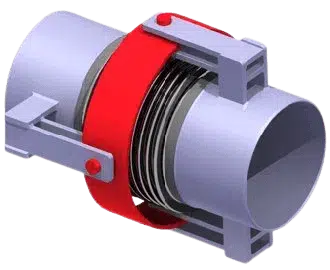
Each component of a piping system has a specific role to play. Ensuring a system functions correctly and efficiently requires designers to thoroughly account for each component’s design, from the conditions at installation (cold) to those during system operation (hot). For this, the gimbal bellows manufacturer, comes in. One requirement of pipe supports is that they accommodate pipe displacement, or movement. It is generated during operation without adding excessive stress to the overall system. Movement results from changes in temperature, load, or any other operating characteristics. It affects the forces at play, whether inside the pipeline or in the environment surrounding the system.
Why Consider Movement in All Three Dimensions?
Piping systems undergo complex 3D movement due to thermal expansion. It experiences pressure changes and external forces. At the same time, axial displacement is often prioritized. Lateral and vertical movements can be equally critical. Ignoring any dimension can lead to costly failures, including excessive stress, leaks, or support damage. Modern systems demand holistic analysis, as movements often combine unpredictably during operation. Advanced supports, such as gimbal joints and sway braces, address multi-directional challenges. The points to be considered:
- Movement Can Occur in All Axes
Designers must never forget that movement can occur in three dimensions: axially, laterally, and vertically. Failure to consider these movements could result in time-consuming and costly retrofitting or repair. Additionally, a gimbal expansion joints manufacturer must assume that any particular support may move more.
- Using Pipe Supports to Accommodate Movement
Pipe support assemblies can be classified according to both their level of engagement and function.
The gimbal bellows manufacturer designates support configurations. The primary capabilities are constantly engaged as active. The passive support configurations follow the movement of the pipe during regular operation. However, disturbances such as severe weather, impact, abnormal vibration, or seismic events can impact the system. It will activate these otherwise passive supports. It then functions as an active anchoring device.
Pipe support functions include load bearing, guiding, or anchoring. A load-bearing support will uphold the weight of the pipe. At the same time, it allows possible movement in all three dimensions. A guide will maintain the weight of the pipe while restricting movement in up to two dimensions. An anchor will completely restrict pipe movement in all three dimensions while bearing the weight, side, and thrust loads.
- Active Support Components
Active support components in piping systems, such as hydraulic dampers, spring hangers, and dynamic restraints, play a critical role in managing stress, vibration, and thermal expansion. These components adjust to real-time forces. It ensures stability while accommodating movement. They prevent pipe fatigue, leaks, and structural damage in industries.
Shoes:
Used as anchors, bearings, and guides. The material used in fabrication usually matches the piping material. It may also depend on operating temperatures.
Hangers:
The hangers are used to support the pipe weight. Rigid hangers consist of components that do not permit vertical movement. However, it does permit lateral or axial swinging. Spring hangers allow both vertical motion and either lateral or axial swinging. Hangers typically consist of a carbon steel structural attachment and a carbon steel rod or rod assembly. It has a pipe attachment fabricated of a material matching that of the pipe. You can get best products from the best gimbal expansion joints manufacturer.
Struts:
Struts are used in either tension or compression to withstand a pipe force. The movement allowed is determined by the strut’s orientation (hanging, horizontal, or vertical). Consists of an end bracket connected to a clamp element (e.g., yoke, clevis) fabricated of carbon steel.
Sway Braces:
It is primarily used to restrain forces other than those of the supported pipe weight. Part of the pipe movement can be accommodated by changing the orientation of the brace, with the sway brace spring coil allowing additional movement via compression and decompression. Usually consists of a carbon steel structural attachment, a carbon steel spring coil, and a pipe attachment fabricated of a material matching that of the pipe.
Customized Support:
The customized support includes project or industry-specific components. Examples include custom-built frames upon which pipe will rest and multi-pipe channel assemblies. It is sometimes called random hangers.
- Passive Support Components
Snubbers
The snubbers are used to restrain piping that undergoes unwanted, abrupt movement in one axis. Under normal operating conditions, snubbers follow the movement of the pipe. However, the snubber can be either mechanical or hydraulic. It acts as a rigid restraint. The amount of stroke provided as part of the snubber design determines the amount of pipe movement allowed under normal conditions.
When active and passive support assemblies cannot meet specific system requirements, the designers can add auxiliary components. They are designed to extend the range of motion. These supports can be accommodated during regular operation.
The Conclusion
In demanding industrial environments, complex pipe movement requires tailored solutions. It ensures safety, efficiency, and longevity. Custom-engineered expansion joints, flexible bellows, and active supports address unique challenges. Whether handling extreme temperatures, high pressures, or multi-directional stress. Contact Flexpert for customized solutions in piping systems and get the best results.