
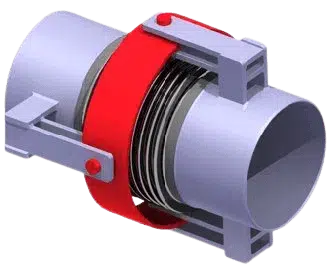
Pipeline systems are flexible systems that require not only the ability to handle pressure but also the capacity to manage changes in temperature, vibrations, and loads. A gimbal expansion joint manufacturer creates products that make it possible for pipelines to manage such changes without stressing associated equipment or pipelines.
Stress analysis will help the engineer determine how the pipeline responds to varying operational stresses. The identification of sections where there might be excessive movement and stresses will enable the engineer to select the appropriate materials, positioning of supports, and minimize the possibility of failure.
Top Role of Stress Analysis in Maintaining Flexible Pipeline Systems
Flexible pipelines should be able to withstand stress due to temperature, pressure, vibrations, and equipment variations. The slightest weakness may bring a lot of problems after some time. Stress analysis ensures that the flexible pipeline is safe and reliable.
- Identifying where stress builds up
From stress analysis, the engineers are able to determine where the stresses act in a pipeline. The bends, joints, supports, nozzles, and connecting points tend to have higher stresses than the straight pipe segments. Finding these areas early makes it easier to reinforce the design before the system goes into operation.
- Selecting suitable expansion components
Flexible components need to match the movement and operating conditions of the pipeline. A gimbal bellows manufacturer can produce components designed to accommodate specific types of axials, lateral, or angular movement. Stress analysis provides the information engineers need to determine what level of flexibility is required rather than choosing a component based simply on pipe size.
- Managing equipment movement
Sometimes, pipelines are attached to pumps, compressors, turbines, tanks, or any other machinery that has some amount of movement during its operations. This movement can become a source of stress when there is no flexibility in the connection. Expansion loops and properly chosen expansion joints provide enough freedom for the pipeline to react.
- Checking pipe support locations
Supports are not only significant in the context of supporting pipelines. The location of supports influences the reaction of the pipeline to stresses that come from bending, thermal effects, and weight load. Incorrect positioning of the supports may impede the movement of the pipeline and cause stress concentrations, resulting in various problems with it. For this reason, stress analysis is done to establish a compromise between stability and flexibility of the pipeline.
- Protecting connected equipment
A major advantage of effective stress analysis is that the loads that are not required can be minimized in terms of equipment. Pipe forces that are too much may damage the shaft of pumps, compressor joints, valves, and other equipment. Through pipe movement control, engineers can save these joints.
- Improving pipeline routing
The most straightforward-looking path for a pipe is not always the one that generates the least stress. A straight path has fewer opportunities for absorbing thermal movement than a path with well-placed curves. This makes stress analysis useful in comparing the various paths available and selecting the best one.
Conclusion
Stress analysis helps provide a better way to operate flexible pipe systems safely and efficiently. This is because stress analysis helps identify the critical areas of stress, considering movement as well as choosing the appropriate supports and flexible parts that will help increase the system’s lifespan.