
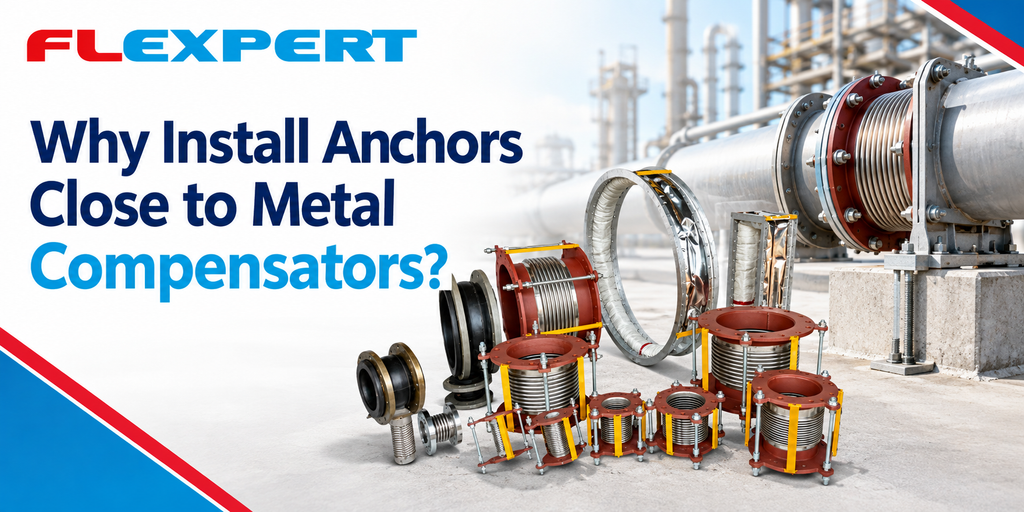
The task of metal compensators is important for pipes; however, they need good support to be safe. Anchors play the role of this support. Expansion bellows can compensate for motion due to heat, pressure, and vibration, but anchors near expansion bellows allow management of the motion along the pipe. The presence of anchors near metal compensators helps stabilize the whole system and directs the movement in the correct direction for compensators.
Failure to provide a proper anchor will cause additional stress to be exerted on the joints, supports, and any other equipment attached to the pipe. A properly placed anchor assists in controlling the motion and minimizing the forces within the system. Moreover, it increases the efficiency of the compensator and minimizes the chances of future damage. This is why placing anchors near the metal compensator is highly recommended.
Various Reasons to Install Anchors Close to Metal Compensators
Anchorage plays a very significant role in ensuring the safety and dependability of a piping system. The installation of anchors in proximity to the metal compensators can regulate pipe movement and stress.
- Controls pipe movement
Metallic compensators are made to deal with movements in a pipeline. This occurs because of the presence of heat, pressure, vibration, or changing conditions of operation. Anchors are designed to regulate the movement of the pipeline, where some parts may move, and other parts do not move. When an anchor is provided in the vicinity of the compensator, the entire system becomes highly effective.
- Helps extend component life
Movement that occurs repeatedly could have an effect on piping parts. Stress may result in wear and tear, cracking, leakage, and other issues. Appropriate anchorage minimizes unnecessary movement and ensures that the stresses are kept under control. It is always advisable to work with an experienced expansion bellows manufacturer when selecting the compensator and appropriate anchorage.
- Helps the compensator work properly
The metal compensator must be provided with appropriate conditions for it to be able to take up the movement. If the movement is not properly directed, the compensator will not work effectively. This is where the role of the anchor comes in. It gives a reference point for the movement to be directed towards the compensator.
- Supports thermal expansion
Changes in temperature may affect the expansion and contraction of the pipes. In piping systems that experience high temperatures, an increase in temperature by just one degree may cause movement of the pipe along its length. An anchor that is placed correctly will help to control this movement and provide space for the operation of the compensator.
- Prevents unwanted lateral movement
All movements of a pipe are not always effective or anticipated. For example, the function of a compensator is to accommodate a certain type of pipe movement; any unwanted lateral movement will create additional stress. However, by anchoring the pipe, one can ensure that the unwanted pipe movement does not occur.
- Helps manage pressure forces
The force due to internal pressure can act within the pipe network, particularly in areas of change in direction and flexible pipe sections. The consideration of this force must be done to determine the point of installation of the anchor. A good anchor will assist in resisting this force and ensuring that the pipe segment is well controlled.
Conclusion
Fixing of anchors adjacent to metallic compensators can be useful in the management of movement of the pipes and in stress reduction in the entire piping system. Proper placement of anchors helps in the effective working of the compensators.